How Aviator Works: The Plain-English Explanation
In Aviator, each round begins with a multiplier (for example 1.00×) and increases smoothly upward.
Think of it as a live counter that climbs: 1.10×, 1.25×, 1.60×, 2.05×, and so on.
The round ends at a moment you do not control. If you cash out before the round ends, you receive a payout based on the multiplier at the moment you cashed out.
If you do not cash out in time, your bet for that round is lost.
The game is designed to be fast and readable. Most interfaces show: (1) a betting panel where you enter stake and optional auto-cashout, (2) the live multiplier display,
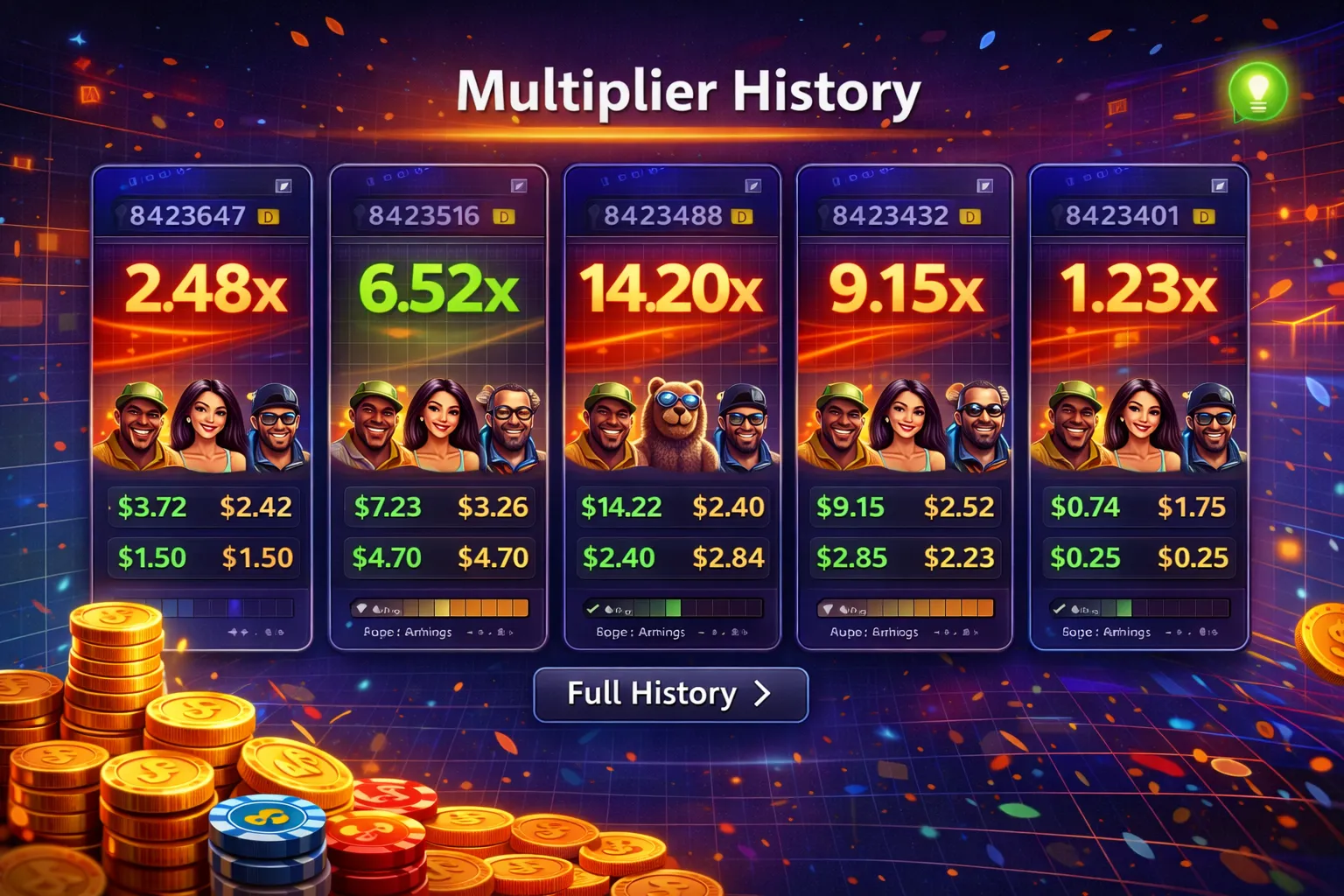
(3) recent round history, and (4) a list of players and cashout multipliers. The “simple look” can feel inviting, but it is still a wagering product:
results vary round-to-round, and no pattern guarantees an outcome.
Common Terms You Will See
| Term | Meaning | Where it appears |
|---|
| Multiplier |
The value that increases during a round (e.g., 1.80×). If you cash out at 1.80×, payout is stake × 1.80 (minus any applicable fees/commission). |
Main game screen |
| Cash Out |
A button/action to exit the round. You lock your multiplier at the time of cashout. |
Betting panel |
| Auto Cashout |
A preset multiplier (e.g., 1.60×) where the game attempts to cash out automatically once reached. |
Betting panel settings |
| History |
Recent crash points (where the round ended), often shown as a list like 1.05×, 2.30×, 8.10×, etc. |
Side panel / bottom strip |
What Makes Aviator Different From Slots or Table Games?
Aviator is not a slot reel and not a traditional table game. It is a timing-based decision game built around a rising multiplier.
The round ends unpredictably; players decide when to lock in a multiplier. This creates a “tension curve” that can feel more interactive than pressing a spin button.
However, interactivity does not mean control over the end point. Your choice is “when to exit,” and that choice is made under uncertainty.
Many operators also support two bet boxes per round, which lets a player place two separate stakes with different auto-cashout levels.
Some people use that to structure risk, for example one smaller “early cashout” and one “let it ride” bet. If your platform supports it, you will see two rows of stake inputs.
Whether you use one or two bets, the fundamental rule stays the same: cash out before the round ends, or the bet is lost for that round.
A Typical Round, Step by Step
The visual experience usually repeats in short cycles. During a countdown or pre-round phase, you can place a stake. When the round starts, the multiplier begins increasing.
You can cash out manually at any time while the multiplier rises. When the round ends, the interface shows the final crash multiplier (where it stopped) and the round resets.
- 1) Choose stake: decide the amount you are comfortable risking for a single round.
- 2) Optional: set auto-cashout: if available, set a multiplier where your bet will attempt to cash out automatically.
- 3) Start of round: the multiplier rises from 1.00× upward.
- 4) Cash out: lock in your multiplier. Your payout is calculated from that point.
- 5) Round ends: if you did not cash out before the crash point, that bet is lost for the round.
Understanding the Interface Panels (Images + Meaning)
To avoid confusion, it helps to recognize what each panel is responsible for. Below are two typical panels.
Your app may look different, but the logic is very similar: stake, cashout controls, and history.
Bet Panel
The bet panel is where you set your stake, choose auto-cashout (if available), and start/cash out.
It often shows balance, minimum/maximum limits, and sometimes two bet boxes.
History & Recent Crash Points
The history panel lists recent crash multipliers. People often look at it to “feel” volatility.
Treat it as a log, not as a predictor. A sequence of low crashes does not guarantee a high one next.
Aviator Deep Guides
Use these focused pages to understand how key features behave on real interfaces, what common limits mean, and what to do when something doesn’t work.
Game Mechanics
Round phases, multiplier timeline, and what each screen state means.
Open
Auto Cashout
How auto cashout works, common targets, and why it might not trigger.
Open
Two Bets
Dual bet explained with examples and common mistakes.
Open
Bet Limits
Minimum/maximum bet, max payout, and other common limits.
Open
Is Aviator Legal in India?
Rules for real-money gaming can vary by state and by operator licensing. Some platforms restrict access by location, age, or verification.
Always check the terms of the platform you use and follow local laws. This site is informational: it explains how the game works and what common UI elements mean.
Practical Safety: Limits, Time, and Decision Hygiene
Crash games are designed to be fast. Speed can lead to impulsive decisions, especially after a loss.
A good approach is to decide a session budget and a session time cap before opening the app.
Consider stepping away after a preset number of rounds rather than “playing until it turns around.”
| Area | Simple rule | Reason it helps |
|---|
| Session budget |
Only risk an amount you are prepared to lose in full. |
Prevents spiral spending when outcomes are unfavorable. |
| Time limit |
Set a timer (e.g., 20–30 minutes) and stop when it ends. |
Reduces fatigue-driven decision making. |
| Loss-chasing |
Never increase stake solely to “recover” quickly. |
Limits the most common escalation pattern. |
| Breaks |
After a streak (win or loss), pause for 5 minutes. |
Interrupts emotional momentum. |
Where to Go Next
If you want a clean walkthrough of the buttons and what to tap during each phase, use the How to Play page.
If you are comparing platforms, the Rules & Payouts page covers typical limits, how payouts are calculated, and what “auto cashout” does.
If you have questions about fairness, randomness, or RTP-type metrics, the Fairness & RTP page gives a structured explanation and a checklist of what to look for.